
of Clocks and Numbers
Imagine a clock that has no notion of time.
Such a clock would have an empty dial, no numbers written on it.
The set of all the values it could take would be
Ø empty and count zero members.
A primitive clock indeed! No relation to time whatsoever.
Hardly a clock, but in name.
Once upon a time
Now watch a next generation clock, containing a single notion of time.
Maybe it moves like a regular clock
or maybe it stands still as on the photograph,
but it will always tell you the time is “NOW”
...meaning your time to act is ‘now’ perhaps?
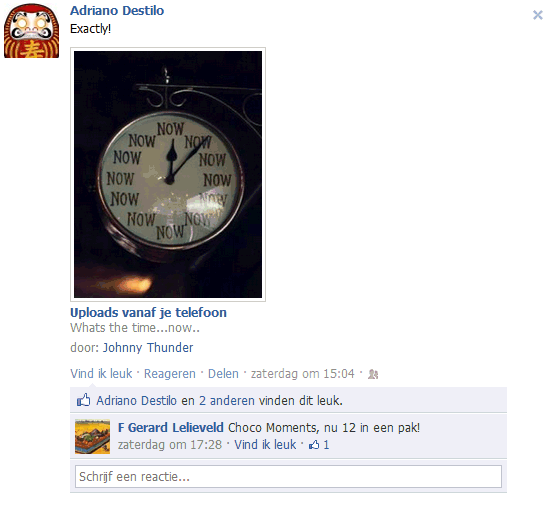 This particular clock has two hands –
one for hours and one for minutes –
but that doesn't really matter,
because both count up to the same, continuous, eternal, present moment.
This particular clock has two hands –
one for hours and one for minutes –
but that doesn't really matter,
because both count up to the same, continuous, eternal, present moment.
Represent this moment by the number 0,
the only member in the set {0}
of all values the present clock can take.
Compare this {0} clock with an ordinary clock with hours
in the range from number 0 inclusive
to number 12 exclusive.
Within this range or set the numbers will represent any moment in time
modulo 12 hours.
You can do modular arithmetic on a regular clock.
So the mark for a day 24 ≡ 0
is congruent to twelve o'clock and its number is 0.
Then add 9+4 ≡ 1 o'clock,
subtract 1-4 ≡ 9,
multiply 7*2 ≡ 2
and divide 1/4 to a quarter.
Now tell me, is the above {0} clock
congruent modulo some number?
Indeed for integer (whole hour) purposes it seems to be congruent
modulo 1.
But when we look at fractions p/q,
these too are part of the continuous “NOW”
and thus congruent to 0
and not to some base range fraction.
Perhaps if we could agree on a smallest limit of precision m,
then our present clock could be thought to measure time
modulo m,
the de facto smallest number.
For a physical clock this might be feasible,
but a mathematical clock works with infinitesimal precision.
How deep can “infinitely small” be?
If we stop at nothing but 0
our present {0} clock is not modulo anymore.
Because there is no way to calculate congruences,
when you have to divide numbers by a zero measure.
So the number dial on our one-time clock is not modular at all?!
In infinite time
To search for a smallest number in mathematics is the same
as trying to name the largest number
– you can always take it a little farther
– divide it up / add 1 more.
Unless... you define some even larger number
that lies outside of the reach of finite arithmetic,
which is just what mathematicians have been doing
for more than a century.
Cantor's omega ω is used
to count the total number of counting numbers
(the size of the set of natural numbers), with proven success!
Obviously a clock of one time leaves plenty of numbers
that finite hands don't point at.
What ω infinity is for the countable numbers
is the number 1 on our {0} clock –
it is never reached.
The {0} clock being our small mathematical laboratory,
we first want an inventory of what type of numbers lie in scope.
That is, which numbers x:={0}
can be substituted by zero.
0itself1≡0thereforem = n+1the natural numbers-1≡0thereforem = n-1the integersm+..0 #k = nthe fractionsm*..1 #k = nthe algebraic numbers- continuous now, therefore the real numbers
0*..0 #k ≡
1*..1 #k = 1 ≡ 0
therefore zero-powers0*0 ≡ 0 ≡ -1therefore the complex numbers
So all numbers below infinity are congruent to 0
on our clock where all time is one.
Then represent infinity by 1 on a higher clock.
That is, 1 is to our {0} clock
as infinity ω is to the set of natural numbers
– unreachable.
Now what may this higher, second clock look like?
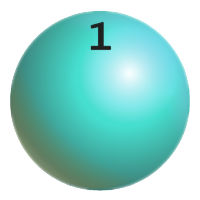
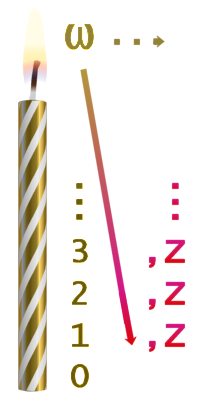 On the left the new
 {1} clock works
like the projection of the {0} set
on all finite numbers before.
But now ω and all infinities issued by ω
are represented by the number atom 1.
On the right we take a constructive approach
and slowly burn up infinity by recursion.
Here ω is plugged in to
a recursive algorithm without bounds.
Wildcard Z stands for finite
(or same level infinite) continuation of the expression.
Eventually an infinite number of
infinite iterations over ω...
is created. This covers the level of recursive ω
infinity or Ω(1)
similar to the set of Big natural numbers Ω(0)
that arises when we plug in only finite numbers.
But there is a difference.
In Ω(0) all expressions can eventually be reduced
to natural number 1.. #n
and word sequences in the intermediate calculation will
have finite length.
In Ω(1) intermediate words can be repeated
#ω... infinitely,
even though the original expression
usually has a finite, small size.
For example, rules to evaluate expressions, in order,
with variables v≠0 and possibly empty wildcards.
- rule
(ω,b) =
  (ωn) = ω+b
add - rule
(ω,1,Z1) = ωinner one - rule
(ω,b1,1) =
  (ω,(ω,b,1)) == ω*(b+1)
multiply (ω,b1,c1) = (ω,(ω,b,c1),c)superpowers- rule
(ω,b,Z,) = (ω,b,Z)outer zero (ω,b,1...Z) ,1#p1 = (ω,b,1...,b,Z) ,1#p-upload- rule
(ω,b1,1Z) =
  (ω,(ω,b,1Z),Z)
main motor
This first array row already facilitates the construction
of very Big infinite numbers.
Next comes the introduction of array type separators
,(X)
nested to arbitrary depth, which (hey!) requires no extra characters.
But to implement recursion over array nesting depth
a new type of character has to be added for sure.
After a long time these signs (in various combinations) are exhausted too,
another character follows, and we can begin to think to
iterate over the size of our alphabet directly.
Take a step back to remove ω from the algorithm
and you get the idea of a Big number machine
that crushes
Chris Bird's
world record numbers easy.
And you can see that the Church-Kleene thesis is solved in favour of recursion,
which wins over computability,
as a specific Turing machine requires a fixed alphabet.
Going further we transcend the arithmetical hierarchy
of Turing machines – though a “hierarchy”
in the sense of a staircase isn't a workable concept –
it is more like a Big universe of machine codings or alphabets,
that are interconnected. Numbers from higher alphabets
inflate the lower alphabets and vice versa, because
we take the upload principle to its extreme
and count all higher structures
(starting with row size, dimensions, etc.)
by the value accumulated in the lowly parameter b.
New structures and algorithmic rules can be added almost indefinitely,
but somewhere our finite collection of Big number tools must end.
So in Ω(0) we will never reach
ω and in Ω(1)
where ω
is a given, we will never reach an even higher infinity
that will be surmised in Ω(2).
Is it alright to think of Ω(2)
as a realm of numbers that would come into reach when
the algorithmic tools to inflate ω
were ω infinite?
Jumping from time
We can index further levels of infinity beyond Georg Cantor's
by expanding Ω(X) directly,
like we expanded natural number expressions (X)
in the style of
Jonathan Bowers and
Chris Bird
(and then Kurt Gödel and Alan Turing) in the last section.
At the end of our idealized algorithm each infinity can be thought
to fall short of the next,
and the indexing apparatus of Ω(X)
or (Ω,X)
follows as a consequence.
Some examples.
(Ω,0)natural numbers(Ω,n)indexable levels of infinity(Ω,1,Z) = ωinner rule(Ω,b,c) = (Ω,(Ω,b-,c),c-)Ω superpowers
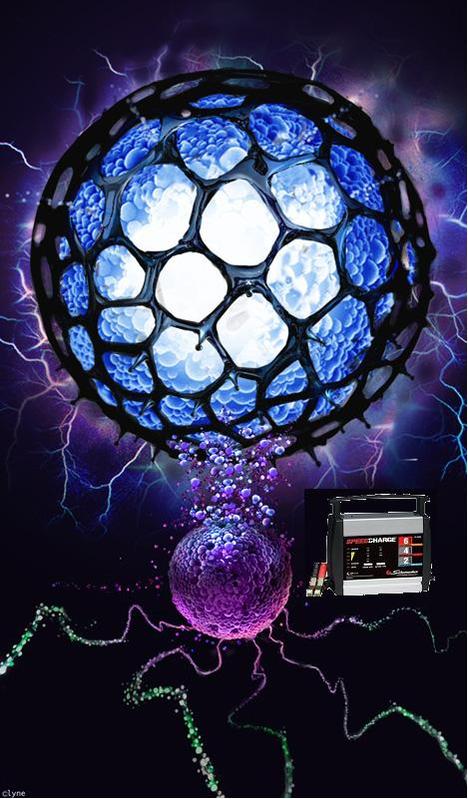 This looks the same as the start of the rule list in the previous section,
with the main difference that we are dealing with completely separated
levels of infinity here.
What we are counting is the number of times the previous algorithm
could be transcended by another type of infinity.
This looks the same as the start of the rule list in the previous section,
with the main difference that we are dealing with completely separated
levels of infinity here.
What we are counting is the number of times the previous algorithm
could be transcended by another type of infinity.
Nevertheless, just as the natural numbers of Ω(0)
had to end below the ω of Ω(1)
so the algorithm Ω(X)
for indexing levels of infinity can be transcended
by proposing a higher kind of jump.
Remember that we let our “NOW” clock {0}
cover finite time and thereby the natural numbers
(and as we figured, the complex too).
The next clock {1} lived on the level of infinity
constructed from ω
in any finitely defined recursive algorithm
(ω,X).
Then propose a new clock {2} that handles all recursive levels
of infinity possible in (Ω,X)
and a jump clock {3}
to follow suit.
We can only start to paint where clock {3} is heading.
The jump at hand asserts the existence of an infinity
that cannot be reached by Ω type recursion
and of further levels of infinity beyond that.
If Ω is the first infinite function constant,
we take Ψ to be its embedding, where
Ψ(1)
= (Ψ,1)
= Ω
so that Ψ(2)
paints the second function of infinity levels
right after the jump.
Notice that the concept of a new clock {n}
is not easy to define –
every next clock involves a whole new paradigm.
And it is not useful to try to iterate over future paradigm shifts.
In fact what we stumbled on is either the limits of the human mind
or the bounds of the mathematical universe –
somehow we cannot build Bigger numbers as fast as we would like to.
When we see {0,1,2} you'd like to think
{3,4,5} but how?
I challenge the machines that come after us to elaborate on this.
Or you are not worth the batteries you are running on!
Time of our life
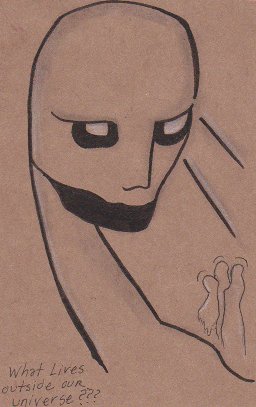 The biggest changes for mankind are the windows and doors
to a wider existence that have opened only recently.
In our lifetime we have found a world that is so large,
with so much structure – with what we know now
and didn't know a century ago,
there must be enough challenges ahead for a million years!
The biggest changes for mankind are the windows and doors
to a wider existence that have opened only recently.
In our lifetime we have found a world that is so large,
with so much structure – with what we know now
and didn't know a century ago,
there must be enough challenges ahead for a million years!
— Giga Gerard
The Hague, 17 April 2012
drawing by Jen Clark ©2012